May 2026 Reading Roundup

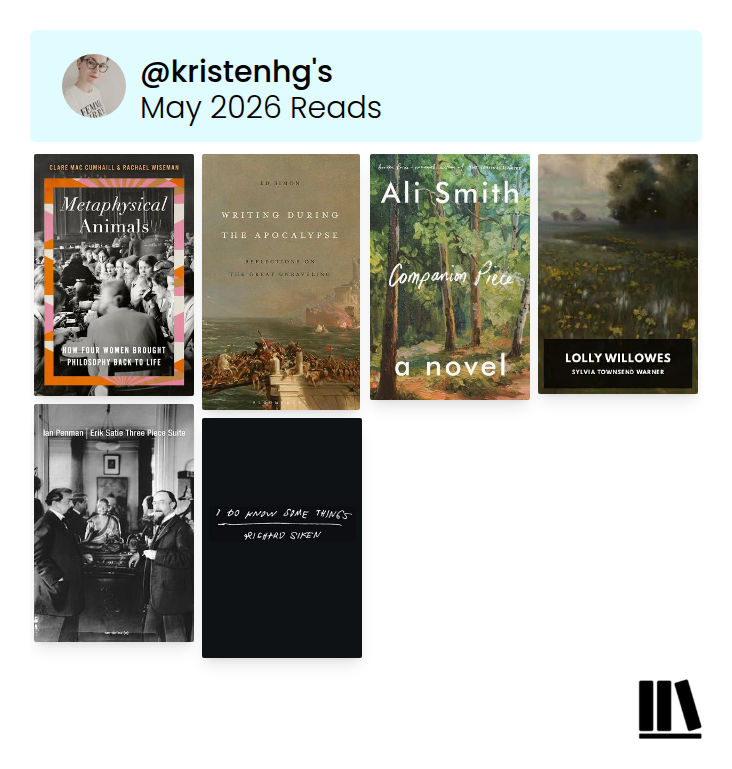
I'll admit that rounding up my reading this month is more of a struggle than usual. I read good books! I liked them! But I'm also very aware that I have a book proposal that needs major changes, and they are not the easy kind. It needs a complete overhaul before I can send it out again and feel good about the project I'm presenting to agents and publishers. It's all I want to think about, and I cannot think about it anymore. It's my only topic of conversation, and if you ask me about it I will change the subject. So these are the books I've been reading as a kind of avoidance strategy, and this is the newsletter I am writing when I should be taking yet another stab at a sample chapter.
Anyway.
Metaphysical Animals: How Four Women Brought Philosophy Back to Life by Claire Mac Cumhaill and Rachael Wiseman is the story of Iris Murdoch, Phillipa Foot, Elizabeth Anscombe, and Mary Midgely, who met at university in England during World War II and influenced the course of philosophy after the war. I am a fan of Murdoch's and figured I could do with learning more about the others. It's more compelling than you might assume for a behind-the-scenes account of four philosophers building their lives and their bodies of work. I enjoyed it. https://bookshop.org/a/7065/9781984898982
I got an email in my inbox from Bloomsbury letting me know that it was publishing a new title I might be interested in: Writing During the Apocalypse: Reflections on the Great Unraveling by Ed Simon. I was indeed interested, so I ordered it. The name sounded familiar, so while I waited for the book to arrive I looked up Ed Simon. It sounded familiar because he edited a piece I had published in the Pittsburgh Review of Books! I am very good with names, clearly. As you might gather based on the title, it is not a rollicking good time of a book, but it is enlightening, and you will feel less alone as Simon marshals literature to address whatever all this is, and he shares bits of diaristic thought as he lives alongside the rest of us in this mess. Maybe this book is where the ivory tower meets the road, to mix a couple of metaphors. I recommend it if you too rely on your intellect to power you through. https://bookshop.org/a/7065/9798765123218
Feeling the need for some fiction, I scrolled the zillion unread titles on my ereader (a Kobo) and landed on Ali Smith's Companion Piece. I like Smith's writing so much. Here we have a woman tending to her elderly father during the Covid-19 pandemic, getting a call out of the blue from a woman who was barely even an acquaintance in college, and being beset by that woman's slightly unhinged adult twin children. A quote to maybe convince you to read Ali Smith too:
Maybe by the time I'd finished painting something as long as this novel we'd all be well into whatever the next stage of this time in our lives would shape up to be, through the tragedy past the farce.
So say we all. https://bookshop.org/a/7065/9780593315156
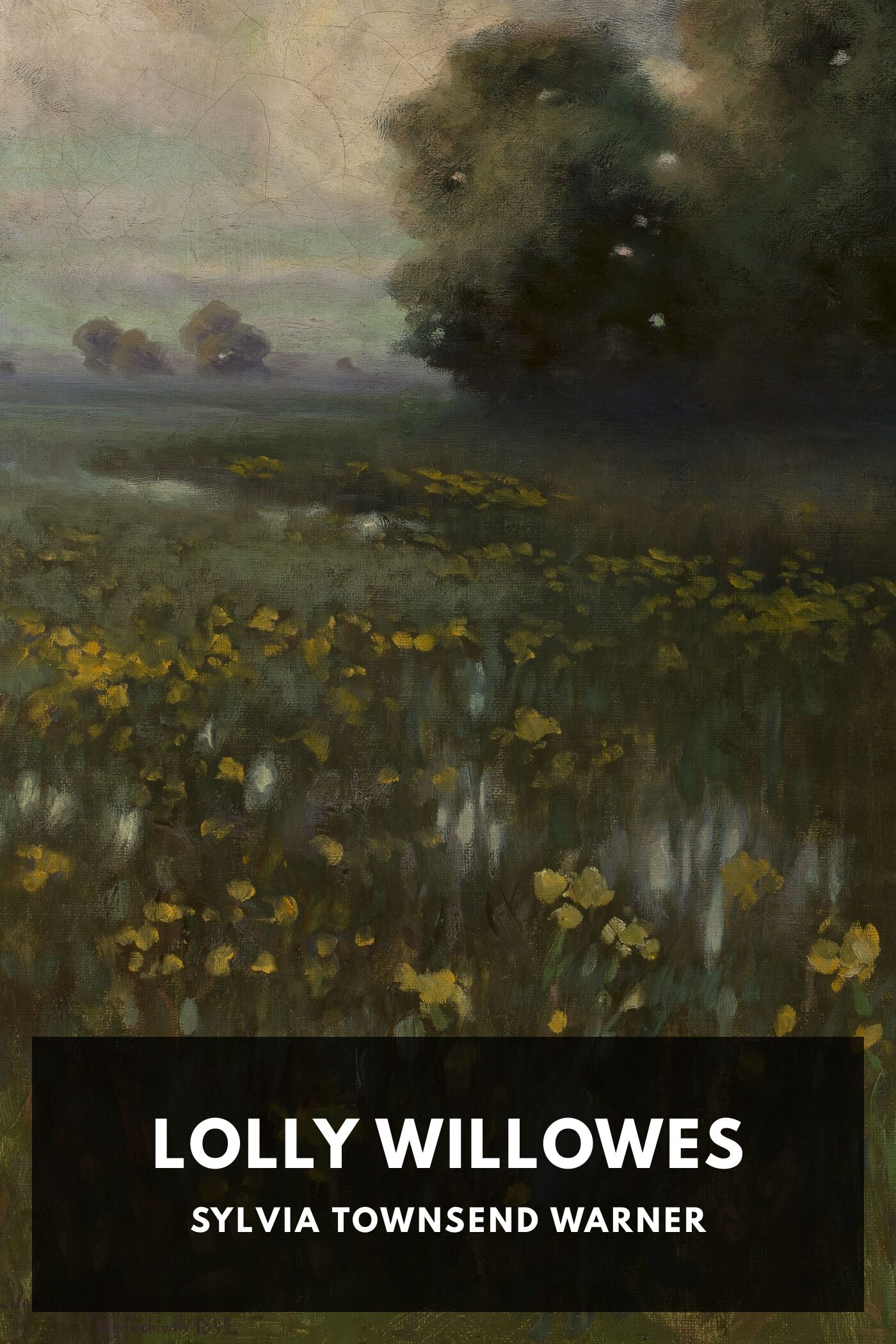
After many recommendations over the years, I finally picked up Lolly Willowes by Silvia Townsend Warner, and if there is one book you read this summer, make it this one. If you have an ereader, Standard Ebooks has a very nice digital edition for free (but donate if you can!). It starts when Lolly is a girl at her family's small rural estate, follows her as an adult to her brother's family's house in London, and then to her true home as a middle-aged lady in Great Mop. I have highlighted so many good lines in this novel, but the one you'll want to get tattooed around your arm is this one:
And all the time being thrust further down into dullness when the one thing all women hate is to be thought dull.
Having read a bit of fiction, I was ready for another nonfiction book, so I took Ian Penman's Erik Satie Three Piece Suite off the pile of paperbacks. This is the very definition of an unconventional biography. Like many books about music and musicians, it's segmented into parts. The first is a fairly straightforward bio, but Penman's style is both light and learned, with no fear of inserting his opinions and associations into the story. The second section is a collection of alphabetical entries pertaining in some way to Satie, from Brevity to the Johns (Cale and Cage) to a dozen entries on the Umbrella, Satie's signature accessory. The final section is Penman's diary of writing the book: what he listened to while he wrote, what connections he made. This is a book to unstick you from whatever is making you stuck. https://bookshop.org/a/7065/9781635902532
Finally, I read I Do Know Some Things, a memoir by the poet Richard Siken. I had put a hold on this at the library, so when it became available, I started reading it. I was halfway through the book before I realized I had no idea why I thought I wanted to read this book. I was not in the mood for it. I felt like I was tricked into reading a whole book prose poetry, which I am extremely picky about, and I generally like it in small doses. If you are more generous than me when it comes to prose poetry, you may enjoy this one. It's really highly regarded by everyone but me.
 Richard Siken
All links to Bookshop.org are affiliate links that help keep The Wingback Workshop working. Thank you for your support!
Sign up for the Wingback Workshop email newsletter (including the email-only Sawdust!) using the Subscribe button at the bottom of your screen. Paid subscriptions buy me time to write more essays for the newsletter.
Get the Wingback Workshop RSS feed here: https://wingbackworkshop.com/rss
Follow the Wingback Workshop on the Fediverse (including Mastodon): @khg@wingbackworkshop.com
Buy KHG's books on Bookshop.org: https://bookshop.org/shop/khg